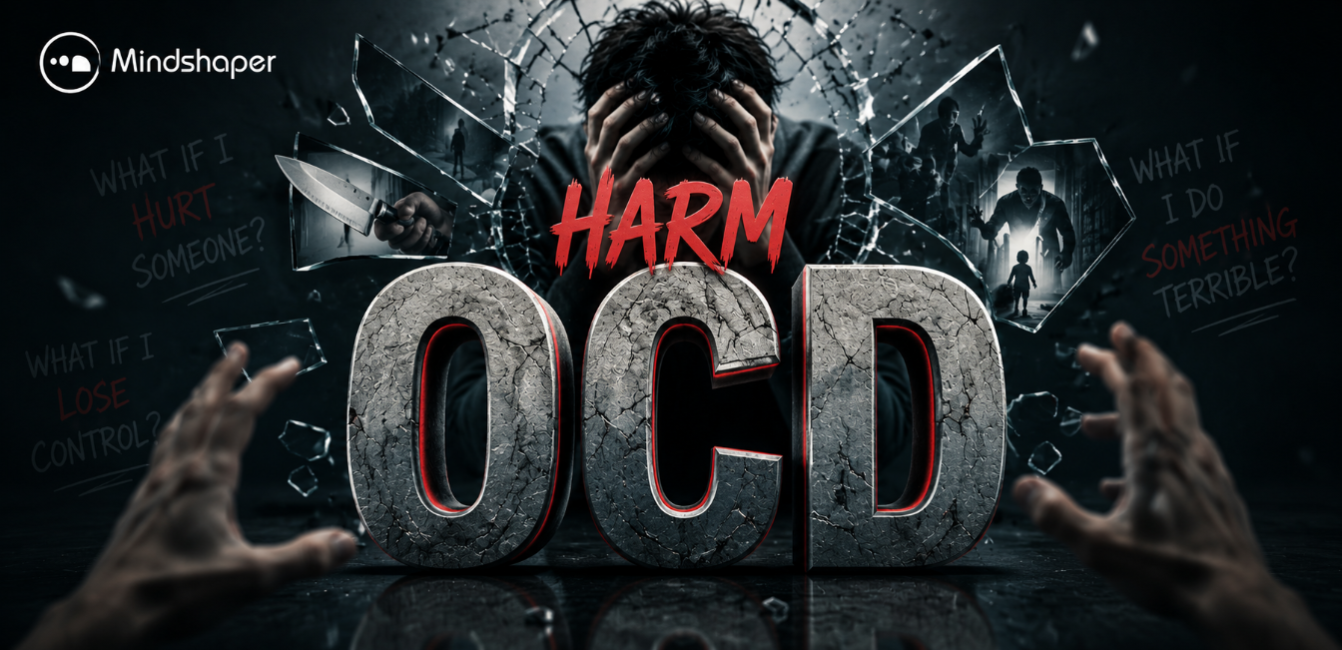


If You're Worried About Harmful Thoughts, You're Not Alone
Having sudden, unwanted thoughts about hurting other people can be scary, but they're more common than you might think. These thoughts don’t mean you’re a bad person. If they cause you anxiety, you might be experiencing a type of obsessive-compulsive disorder (OCD) called harm OCD, which is both common and treatable.
What Is Harm OCD?
Harm OCD involves unwanted thoughts or fears about hurting others, either by accident or on purpose. People with this condition:
- Constantly worry about these thoughts
- Feel intense guilt and fear over having them
- Try to avoid anything that could lead to harm, like sharp objects, driving, or being around children
These thoughts can take many forms—fears of stabbing someone, hitting a pedestrian, or even inappropriate sexual thoughts. What’s important is that these thoughts are "ego-dystonic" they go against the person's values and who they really are. In fact, the distress they cause is a key sign it's OCD.
Global OCD Prevalence
- OCD affects an estimated 1–3% of people worldwide, equivalent to roughly 70 million individuals.
- Lifetime prevalence commonly hovers around 2–3%, with 1–3% of children and adolescents affected.
- Current (12-month) prevalence is about 1–1.8%, with lifetime rates between 1.1–1.8%.
OCD Prevalence in Bangladesh
- According to the Bangladesh National Mental Health Survey 2018–19, adult OCD prevalence is 0.7% nationwide.
- Among children (ages 7–17), OCD is not listed among the top five childhood mental disorders by that study, suggesting lower prevalence, likely below ~2.3% for anxiety disorders in that age group.
Psychological Explanation of Harm OCD
1. Nature of Obsessions
Harm OCD is rooted in ego-dystonic thoughts—thoughts that directly conflict with a person's values and self-image.
Common intrusive thoughts include:
- What if I push someone in front of a train?
- What if I lose control and stab my family?
- Did I actually hit someone with my car and not realise?
These thoughts are not fantasies or desires. They are feared possibilities, and people with Harm OCD are usually horrified by them.
2. Compulsions & Avoidance Behaviours
To reduce the anxiety caused by these intrusive thoughts, people often engage in compulsions such as:
- Mental rituals: Reviewing past events repeatedly to make sure they didn't act violently.
- Avoidance: Avoiding knives, crowds, driving, or even loved ones.
- Reassurance-seeking: Repeatedly asking others if they seem dangerous or whether everything is okay.
3. Cognitive-Behavioural Model
According to Cognitive Behavioural Therapy (CBT):
Everyone experiences strange or aggressive thoughts from time to time.